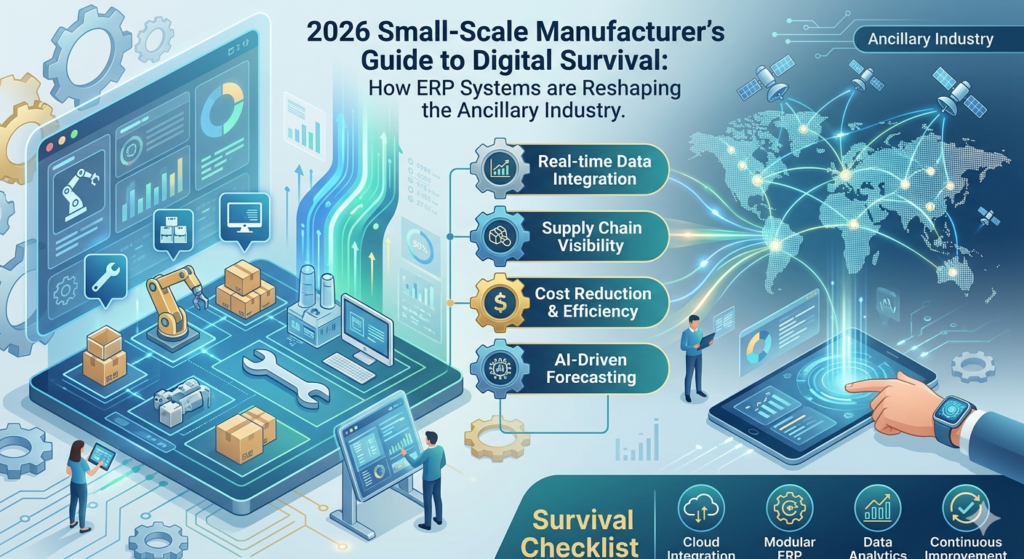
In the high-stakes world of ancillary manufacturing, the margin for error has never been thinner. As we move through 2026, the industry is witnessing a massive divergence. On one side are the units that have embraced Industry 4.0—factories using cloud-based ERP solutions to run with the precision of a Swiss watch. On the other are traditional units, still reliant on paper trails, manual data entry, and the “memory” of senior supervisors.
For the SME manufacturer, digital transformation is no longer a luxury or a “future goal.” It is a vital survival mechanism in a smart factory era.
The Invisible Squeeze: Why Precision is the New Currency
If you are an ancillary unit supplying to Tier-1 or Tier-2 automotive and industrial giants, you’ve felt the squeeze. OEMs are demanding higher precision, faster turnaround times, and 100% digital traceability. At the same time, raw material costs and labor fluctuations are eating into manufacturing margins that were already tight.When you lose a batch due to a “human error” in the technical specifications, or when a machine sits idle because the operator was waiting for a digital job card, you aren’t just losing time—you are losing your competitive edge in the global supply chain.
The Silent Killer: “Information Lag” in Production
Most small-scale units lose 10-15% of their total productivity to what we call Information Lag.
In the context of manufacturing operations management, Information Lag is the gap between an event happening on the shop floor and the management team knowing about it.
- It’s the two hours spent on inventory searching for a specific die or tool.
- It’s the manual data entry of production logs at the end of a shift (often leading to inaccurate OEE – Overall Equipment Effectiveness reports).
- It’s the supervisor spending 40% of his day on “floor walking” just to verify machine status.
In an era of real-time data analytics, you cannot afford to manage your factory in “hindsight.” You need real-time production monitoring.
The Solution: The “Digital Twin” and Centralized Data Systems
To scale, you must move toward a Centralized Data Ecosystem. In advanced Industrial IoT (IIoT), this is often called a “Digital Twin”—a virtual mirror of your physical factory floor.
By implementing an integrated ERP for manufacturing, every piece of raw material, every child part, and every machine cycle is captured digitally. When your data is centralized:
- End-to-End Traceability becomes Automatic: Meet ISO compliance and client audits instantly. No more digging through physical files; just a single-click digital audit trail.
- Automated Inventory Management: Eliminate “stock-out” situations. Your inventory tracking software knows exactly what is in the bin and what is on the dispatch truck.
- Operational Efficiency & Error Reduction: By removing manual data “translation” from paper to Excel, you eliminate the source of most production bottlenecks.
Case Study: The “Paper-to-Digital” Transformation
The Unit: A Tier-2 ancillary manufacturer producing high-precision steel fasteners.
The Challenge: The floor supervisor spent 4 hours daily on “Administrative Friction”—manual job cards, checking bin levels, and reconciling shift reports.
The Probon Flux Intervention: We implemented a centralized digital flow, replacing paper logs with real-time data entry at the source.
The Results:
- Time Reclaimed: 20 hours/week of supervisor time transitioned from “Data Entry” to “Quality Mentoring.”
- Inventory Accuracy: Increased from 85% (estimate) to 99% (actual).
- Lead Time: Reduced by 15% due to the elimination of “Information Lag” between sales and the shop floor.
Mapping Your Digital Journey: A Step-by-Step Approach
The biggest mistake MSME manufacturers make is thinking they need to automate everything at once. Digital adoption is a journey:
- Digitize the Core: Start with production tracking and inventory control modules.
- Bridge the Silos: Connect your sales orders directly to your production scheduling software.
- Data-Driven Decisions: Move from tracking parts to tracking performance. Use real-time data to identify your most profitable lines, eliminate hidden waste (Muda), and make investment decisions based on actual capacity—not guesswork.
At Probon Solutions, we don’t just sell software; we build the digital infrastructure that turns traditional factories into Smart Units. Our flagship solution, Probon Flux, was designed as a customizable ERP for ancillary manufacturing—engineered to eliminate friction and “auto-tune” to your unique business logic.
The future belongs to the manufacturers who can see their data as clearly as they see their machines.